Now Playing
Knowing what is playing is the one thing every other subsystem needs, so it is a subsystem of its own and the others are built on it. It hears or asks each source of music, decides which one is current, completes what it was told, and publishes one answer for everyone else.
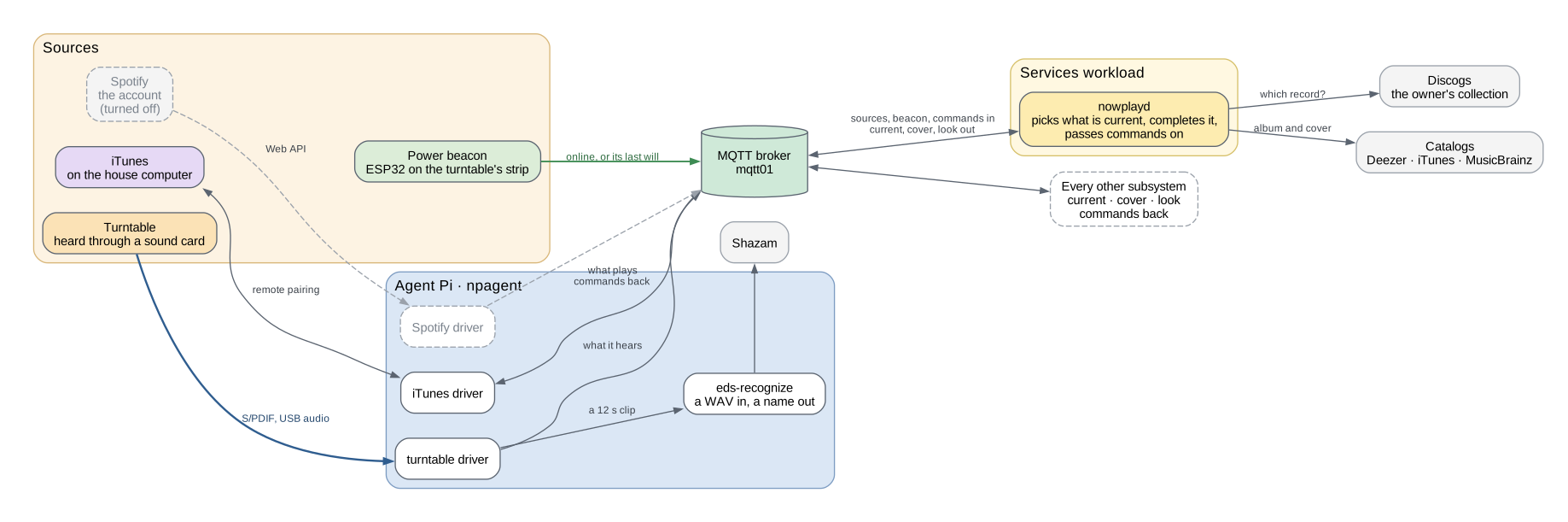
Components
- The drivers (
npagent, on the agent Pi): one for each source of music, iTunes, Spotify and the turntable, each reporting what its player is doing and carrying out commands where the player can take them (ADR-0006). - The recognizer (
eds-recognize): a WAV in, a name out, for the turntable driver. - The power beacon: an ESP32 on the turntable’s switched outlet, whose connection says the turntable is on.
nowplayd, on the services workload: decides which source is current, names the record from the owner’s collection, finds the cover, and publishes one answer for everyone else. It also routes every command to the source that should carry it out (ADR-0008).
Outside services
Now Playing depends on services EdS does not run. Every call to one is counted, a minute at a time, on the Outside Services dashboard (ADR-0027).
| Service | Asked by | For |
|---|---|---|
| Shazam | the turntable driver, through eds-recognize | naming a clip of a record; an endpoint nobody promised, which may stop working any day |
| Discogs | nowplayd | the owner’s collection: which record is on the platter, and its sleeve |
| Deezer | nowplayd | finding the album a track is on, and its cover |
| iTunes Search (Apple) | nowplayd | an album and its cover, when Deezer has none |
| MusicBrainz, with the Cover Art Archive | nowplayd | what each album is, the original among reissues and compilations, and a cover |
| Spotify Web API | the Spotify driver | what the account is playing, and commands (turned off) |
What it offers
The rest of EdS reads Now Playing from these topics, all retained and published in this order:
| Topic | What |
|---|---|
eds/nowplaying/current/look | whether this album has a look of its own |
eds/nowplaying/current/art | the cover, as raw image bytes |
eds/nowplaying/current/art/small | the same cover at 240 pixels, for a subscriber with little memory |
eds/nowplaying/current | the track, the album, and the hash of the cover that belongs to it |
And one it takes: eds/nowplaying/command, never retained, which it passes
to whichever source is current. Field by field, these are in
Now Playing and
MQTT Topics.
One program decides so that everything agrees. The stand, the screen and the console cannot differ about what is playing, because none of them works it out. It also means each lookup is made once and not once per subscriber, which keeps what EdS asks of other people’s services small.
Seen on the console
What Now Playing decides is shown on the console, the page a person looks at: https://console.eds.mobile.deevnet.net/. It shows what is playing whatever the source, a record, iTunes or Spotify, with its sleeve, and the current status of the system around it: which sources are reporting and what each is doing, which devices are online, and the stand’s strip drawn as the stand is drawing it. A device heard recently is shown green; one only remembered by the broker is shown gray (ADR-0034). The console itself belongs to the foundation, since it shows every subsystem.
iTunes
iTunes is asked, not heard. It runs on a computer on the home network, and the broker is inside the Deevnet site, with no path between the two. So the agent Pi stands in both: one leg at home, where iTunes can be found, and one where the broker is (ADR-0010).
The iTunes driver pairs with iTunes once, the way a phone remote does, and
from then on is told of every change as it happens, with no polling
(ADR-0011).
It publishes the cover iTunes holds, then the state that names it. iTunes
knows its own album, so the Discogs collection is not asked; nowplayd
fills in only what is missing.
iTunes is the source that takes commands: play or pause, next, previous, volume up and down from the Remote Display, and an album by name from Voice Request. A track left paused for fifteen seconds is treated as nothing playing; iTunes is still named as the source, so pressing play resumes it.
Spotify
Spotify is read from the account. A driver on the agent Pi asks Spotify’s Web API what the account is playing, every ten seconds, with permission to read playback and to change it (ADR-0012).
It is shown as iTunes is (ADR-0031): the driver takes the album’s picture from the same answer as the track. Until 2026-10-13 it was reported with no cover at all (ADR-0016). It differs from iTunes in these ways:
- Its commands go by way of Spotify’s servers, not the home network (ADR-0032), and only for playback on a device that counts.
- Only named devices count. Playback elsewhere on the account, a phone in a car, is reported as stopped.
- It is turned off, for the calls it makes (CHG-0024), as it was once before (CHG-0011, CHG-0022).
Turntable album detection
A turntable cannot say what it is playing, so it is the longest path through Now Playing: the record is heard, named, and matched to the album in the owner’s collection. This is what happens, from the turntable being switched on to the music stopping.
The turntable is switched on
The turntable is plugged into the master outlet of a smart power strip, which powers its other outlets only while the turntable draws power. Two things come on with it: the converter that turns the record into S/PDIF, and the power beacon, an ESP32 with nothing attached. The strip and the converter are older than EdS (Background: Sound Around the House); the beacon was added to the same strip to learn the same thing, without touching the path the music takes.
The beacon’s connection is its message. It joins the WiFi, connects to the
broker and publishes online, retained, to
eds/beacon/turntable-power-01/status. It knows nothing about turntables;
nowplayd is told which source that beacon speaks for.
From that moment the turntable holds the room: nowplayd makes it the
current source before it has played a note, ahead of anything else that is
playing or paused
(ADR-0023).
This is why lifting the needle does not hand the room to an iTunes left
paused in another room.
The record is heard
A turntable has no data output. It cannot say what is on it; sound is all it gives, so EdS listens.
The sound goes from the converter down the house as S/PDIF, through the switch it shares with the media server, and into a USB sound card on the agent Pi. The turntable driver listens to that input all the time and reports only what it is sure of (ADR-0021):
- silence is
stopped; - music it cannot name yet is
playing, with no track.
That feed is there whether or not a record is on, which is why power and sound are reported separately: the beacon says the turntable is on, the driver says whether it is making music.
The song is named
While music plays, the driver cuts a twelve-second clip and hands it to the recognizer, a small program that sends it to Shazam and prints a title, an artist and an album. The driver knows only “a WAV in, a name out”; the recognizer uses an endpoint nobody promised, and is the one file that would change if it stopped working.
It was chosen because it costs nothing, which was enough to get the turntable going. A paid service with a published API, or fingerprinting the record locally and asking nobody, are both being considered for later. Either would replace that one file and nothing else.
- The first answer after the needle comes down is believed alone.
- After that a different name needs two clips that agree, so one wrong answer does not repaint the room mid-song.
- A second of quiet followed by music is taken as the gap between two tracks: listening starts over and the next answer is believed alone again (ADR-0026).
The driver publishes what it heard, retained, to its own source topic,
eds/nowplaying/source/<id>/state. It looks nothing up and has no cover to
send.
The record and its cover are found
A source that hears a track cannot know which record it is on: the same
song is on the album, a compilation and a box set. So for the turntable,
nowplayd asks the owner’s Discogs collection first, and its answer
replaces the album the recognizer named
(ADR-0022).
The sleeve comes from there too, so the picture is of the record actually
on the platter. If the collection does not have it, the catalogs are asked
in turn: Deezer, iTunes, MusicBrainz.
Then it publishes the topics above. For the turntable, current also says
there are no controls: a record cannot be skipped from a screen
(ADR-0025).
The music stops
After twenty seconds of silence the driver says stopped. nowplayd then
publishes current with no track and empties the cover topics, which is
the one way anything is told there is no cover
(ADR-0024).
Turning a record over does this too; the cover comes back with the first
track named on the other side.
When the turntable is switched off, the strip cuts the beacon’s power. The
beacon cannot say goodbye, so the broker says it for it: its last will,
offline, about fifteen seconds later. The turntable stops holding the
room, and whatever else is playing takes it.