Database Schema
The inventory’s database, as internal/store creates it: SQLite, schema
version 1 (kept in PRAGMA user_version). Nothing but internal/store
reads or writes it
(ADR-0001).
This schema is being reworked; the changes agreed so far are on Proposed Schema, and this page stays what runs until they are built.
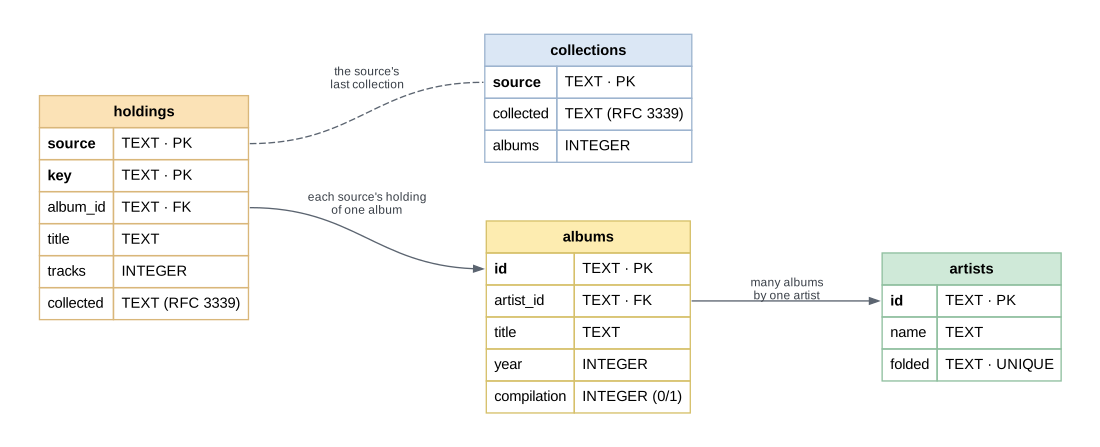
An album is the inventory’s; a holding is a source’s. Each source that holds an album has a holding of it, found again on every collection by the key the source knows it by, so the album keeps its ID. A collection replaces its source’s holdings; an album no holding refers to is removed, and then an artist with no albums.
The picture is drawn by GraphViz from schema.dot, beside this page. Change
it, this dictionary and internal/store/store.go together; a test fails if
a column is missing here.
Data dictionary
artists
Each artist with albums in the inventory. Two spellings that fold alike (“The Beatles”, “Beatles”) are one artist.
| Column | Type | Null | Meaning |
|---|---|---|---|
id | TEXT | no | Primary key. The inventory’s own ID: ar_ and twelve lowercase hex digits, random, never reused. What clients hold on to |
name | TEXT | no | The name as first collected, as a source spells it |
folded | TEXT | no | Unique. The name as names are compared (fold.Name): lowercase, without accents, a leading “the” or punctuation, “&” as “and”. How a second spelling finds the same artist |
albums
Each album in the inventory, whatever holds it.
| Column | Type | Null | Meaning |
|---|---|---|---|
id | TEXT | no | Primary key. The inventory’s own ID: al_ and twelve lowercase hex digits. Kept across collections |
artist_id | TEXT | no | Foreign key to artists.id: the album’s artist, the album artist where a source names one |
title | TEXT | no | The title as the source spells it, so a player asked for it by name finds it |
year | INTEGER | no | The year most of its tracks give; 0 when none does. Often a reissue’s |
compilation | INTEGER | no | 1 when the source marks it a compilation, else 0. A compilation is never an album asked for by its place |
holdings
One source’s holding of one album: that the source has it, and what the source says of it.
| Column | Type | Null | Meaning |
|---|---|---|---|
source | TEXT | no | Primary key, with key. The source, by name: itunes |
key | TEXT | no | Primary key, with source. What the source knows the album by, the same on every collection. For iTunes, which gives albums no ID, the folded artist and title: beatles|abbey road |
album_id | TEXT | no | Foreign key to albums.id: the album held |
title | TEXT | no | The title as this source spells it |
tracks | INTEGER | no | How many of the album’s tracks the source has |
collected | TEXT | no | When the collection that last saw it ran, RFC 3339 in UTC. A holding whose time is not its source’s latest collection is removed by it |
collections
The last collection of each source.
| Column | Type | Null | Meaning |
|---|---|---|---|
source | TEXT | no | Primary key. The source, by name |
collected | TEXT | no | When its last collection ran, RFC 3339 in UTC |
albums | INTEGER | no | How many albums that collection held |
Indexes
| Index | On | For |
|---|---|---|
albums_by_artist | albums(artist_id) | an artist’s albums |
holdings_by_album | holdings(album_id) | an album’s holdings, and finding albums nothing holds |
What is not kept
No paths, play counts, ratings or anything else a source knows of how its music is listened to. Covers, originals and discographies are not kept yet; they come with enrichment.