Sources, Store and Clients
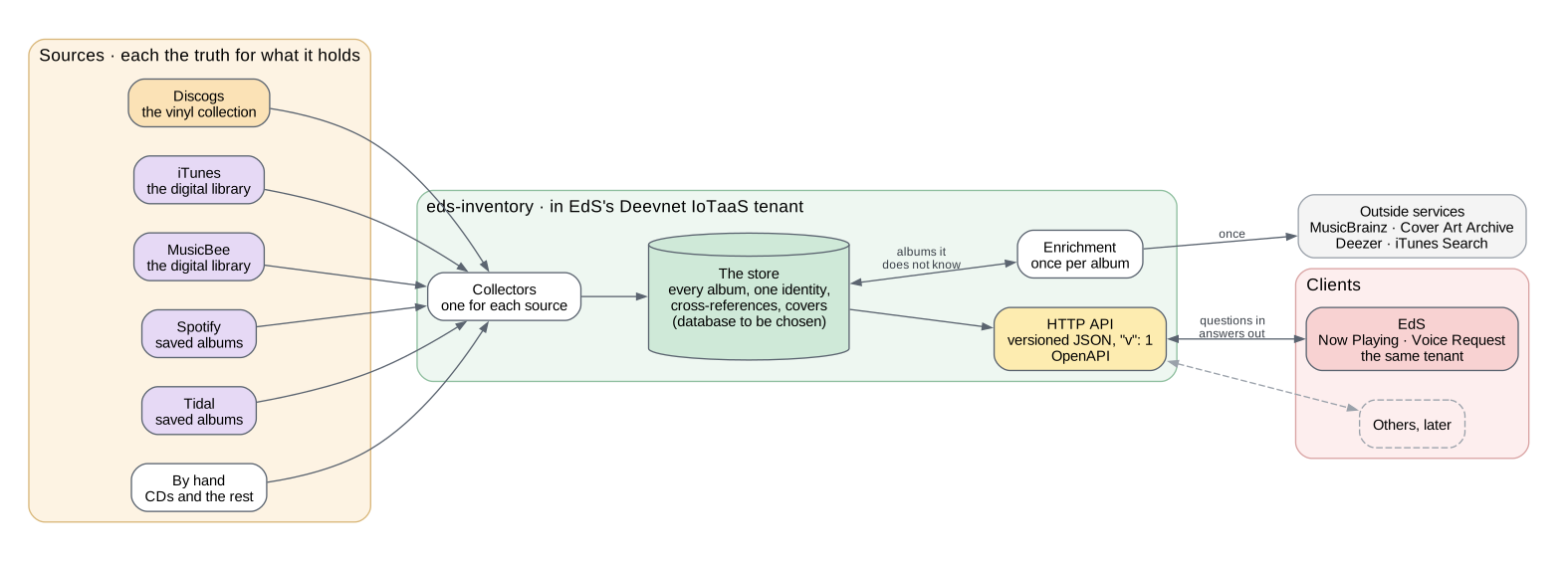
A first picture, drawn before anything is built. It shows the shape the requirements so far describe, and will change as they settle.
Sources
Where the owner’s music is kept today. Each stays the truth for what it holds.
| Source | Holds | Read by |
|---|---|---|
| Discogs | the vinyl collection | its API (open) |
| iTunes | the digital library | its library XML (open) |
| MusicBee | the digital library | open |
| Spotify | saved albums | its Web API (open) |
| Tidal | saved albums | open |
| By hand | CDs and anything else with no service behind it | open |
Collecting
One collector for each source reads what it holds and keeps the inventory in step with it. How often, or on what signal, is open.
The store
One database holds every album, its identity and cross-references, and what enrichment found. What kind is open; SQLite may be enough for one owner’s collection.
Enrichment
When the inventory meets an album it does not know, it asks the services that know about music, once:
| Service | For |
|---|---|
| MusicBrainz | what the album is, its original release, and the artist’s discography |
| Cover Art Archive | the cover, where its terms allow it to be kept |
| Deezer, iTunes Search | finding an album, and a cover when the others have none |
Clients
Clients ask over HTTP, with a versioned contract. The first is EdS, for its Now Playing and Voice Request subsystems.
The picture is drawn by GraphViz from system.dot, beside this page. Change
it there and run make -C docs diagrams; both files are committed, because
the site is built without GraphViz.